


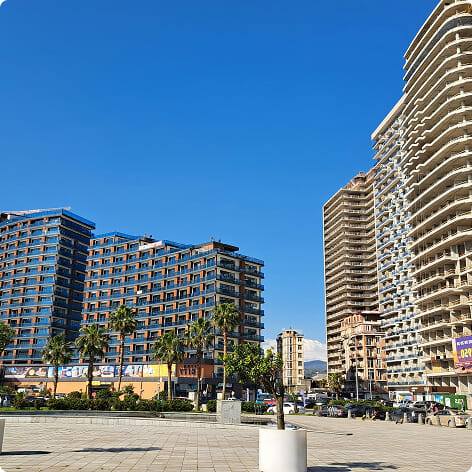
Why Investing in Georgian Property Actually Makes Sense
Buying property in Georgia is rarely about quick flips or risky speculation. Investors usually treat it as a controlled asset — one with clear entry points, predictable exits, and rules you can read before signing anything.
The regulatory setup, tax logic, and state registration system work together in a way that lets you measure legal exposure in advance and calculate financial outcomes long before money changes hands.
-
Equal Property Rights Without Passport BarriersGeorgian law sticks to a simple idea: the real estate market is open, regardless of citizenship. Foreign individuals can buy residential or commercial property outright — no caps on quantity, price, or purpose. There’s no need for a local partner, no special permits hiding behind closed doors. That freedom cuts transaction risks down to size and keeps full control of the asset where it belongs — with the owner.
-
Securing Ownership Through State RegistrationProperty rights in Georgia only come to life once they’re entered into the public registry. This system is centralized and handled by the National Agency of Public Registry. It records the owner, the legal history of the property, and any existing encumbrances. No fog, no half-truths. This structure shuts down grey areas and dramatically reduces the chance of ownership disputes later on.
-
Making Taxes Handleable and PredictableThe tax side of buying property in Georgia doesn’t ambush buyers at the deal stage. There are no extra purchase taxes layered into the transaction itself. Ongoing obligations — during ownership or resale — depend on income generated and how long the asset is held. That clarity makes it possible to build a clean financial model and see real returns without unpleasant surprises.
-
Tapping Into Strong Rental DemandGeorgia’s rental market doesn’t rely on a single engine. Tourism, incoming professionals, and the steady growth of digital and service-based industries all feed demand. In major cities and resort areas, both short-term and long-term rentals remain consistently active. For investors, this turns property into something more than square meters — it becomes a steady cash-flow generator.
-
Entering the Market Without Overstretching CapitalCompared to many European markets, Georgian property prices are still approachable. Residential and commercial assets come with a lower entry point, while price growth potential stays alive thanks to infrastructure upgrades and rising foreign interest. This balance makes Georgia a practical option for spreading capital without locking up massive sums upfront.
-
Using Property Investment to Obtain Georgian ResidencyAs long as the property's value meets the minimum requirement, the law says that real estate can be used as a way to get a Georgian residence permit. For some investors, this transforms a standard purchase into a multifunctional move — combining asset ownership with long-term stay options in the country.
-
Shaping Flexible Investment StrategiesProperty purchases in Georgia can follow many paths: holding value in a finished unit, earning rental income, entering projects at the construction stage, or buying commercial space for an active business. This flexibility lets investors design strategies around personal goals, not rigid regulatory boxes.
Choosing the Right Property Type in Georgia
Buying property in Georgia isn’t limited to one “standard” format. Whether it's for living, renting out, operating a business, or storing capital for the long haul, the market offers a wide range of options, so investors and private buyers can find something that fits a real purpose.
Georgian law doesn’t fence foreigners into narrow choices, and any rights to a property must be officially recorded in the state registry.
The most popular bucket is residential: flats, apartments, private houses, and townhouses. People buy Georgian residential real estate both for personal living and for rental income — long-term tenants or short-term guests, depending on the location and strategy.
Ownership is registered directly in the buyer’s name, including foreign citizens, with no extra permits or special approvals.
Investors and entrepreneurs can purchase offices, retail spaces, hotel properties, warehouses, and premises suited for restaurant projects. Commercial property in Georgia is often used either as the base for an owner’s own business or as an investment asset that earns rent.
The deals go through the same due diligence and registration mechanics as residential purchases — no separate “mystery procedure” for business assets

Rights to Property in New Construction Projects
Georgian law also allows buying claim rights for property that’s still under construction — including very early stages, the classic “foundation pit” phase. In that setup, the buyer registers a formal claim right against the developer, and once the building is commissioned, that right converts into full ownership.
Buying Georgian property at the construction stage is usually cheaper, but it comes with one loud requirement: deeper legal checks of both the project and the developer.
Having access to a wide variety of formats makes it much simpler to tailor an investment strategy to your specific needs, whether that's in terms of time, money, or risk tolerance.
Choosing the Right Region in Georgia
Choosing the region isn’t a “nice-to-have” detail — it shapes everything: your returns, how fast you can resell, and what the property is actually good for. Buying property in Georgia can serve totally different goals, from keeping capital safe to earning steady rent, or leaning into tourism-driven income.




Property Purchase Process in Georgia: Step by Step
Buying property in Georgia follows a clearly regulated route — no improvisation, no “we’ll figure it out later.” For non-residents, two things matter most: a serious legal review of the property and clean compliance with the formalities when the contract is signed. Below is the usual sequence used when handling both residential and commercial deals.
Documents Needed to Buy Property in Georgia
Buying property in Georgia isn’t a paperwork marathon. It’s open to individuals and companies — including foreign buyers — and the formalities stay refreshingly reasonable.
The only real nuance: the document set changes depending on who’s buying (a person or a company) and what the bank may ask for during payment processing
Documents for Individuals
For a deal involving a private buyer, the list is usually short. The point is simple: confirm who the buyer is and register ownership correctly in the state registry.
As a rule, when a foreigner is buying property in Georgia, you may be asked for:
-
a valid international passport (or another ID document);
-
current contact details and address information;
-
proof of the bank transfer, if payment is made cashless;
-
confirmation of the source of funds — this can be requested under bank AML checks, especially for cross-border transfers.
One important thing to know is that bank requirements can change based on the deal's value, the buyer's country, and the currency.
Documents for Companies
If the property is purchased under a legal entity, the document package gets broader.
When buying property in Georgia through a company, you typically submit:
-
the company’s incorporation documents;
-
a corporate resolution approving the purchase;
-
details of directors, shareholders/participants, and authorized representatives;
-
documents confirming the authority of the person signing the contract.
If the buyer is a foreign company, registrars and counterparties often request corporate papers with legalization or an apostille — it depends on the country where those documents were issued.
Key Legal Notes That Matter
Georgian rules do not tie property ownership to having a residence permit. You can register ownership without a residence status — citizenship doesn’t block the transaction.
At the same time, Georgia’s migration framework does allow situations where a residence permit becomes possible because of a real estate investment, as long as the property and the transaction amount meet the established criteria.
So buying property in Georgia can play two roles at once: a financial asset you control, and a practical piece of a long-stay plan — without needing to secure immigration status upfront.
Total Property Purchase Costs in Georgia
The asking price of an apartment or building is only one component of the total cost of purchasing real estate in Georgia.
There’s a second layer — legal and administrative expenses that ride along with the deal. The good news: Georgia keeps this structure pretty transparent. The smarter move is budgeting with the full picture, not only the “object price.”
The transfer of ownership is filed through the House of Justice and then reflected in the National Agency of Public Registry.
Actual registration fees:
-
Standard procedure (up to 4 business days) — 150 GEL
-
Fast-track registration (1 business day) — 270 GEL
-
Same-day registration (on the filing day) —350 GEL
The required fee isn’t linked to the property value and doesn’t change based on who you are — it depends only on how fast you want the registration processed.
If either party doesn’t speak Georgian, the sale contract is prepared with an official translation. In some situations, notarization of signatures is also needed.
Typical cost range:
-
Notarization of signatures + translation — roughly 100–200 GEL+ (the final amount depends on document volume and the notary’s requirements)
-
Translation into Georgian — around 10 GEL / per page, plus a translator’s presence during registration, usually 30–50 GEL / per visit
With cashless payments, factor in bank charges for international transfers, currency conversion, and compliance checks.
For foreigners, these costs can shift depending on the sending country, payment currency, and the bank’s internal policy. The fees vary, but they’re often a fixed amount plus a percentage of the transfer.
That’s why, before buying property in Georgia, it’s wise to lock in the payment method early and align it with bank procedures — not after the contract is already on the table.
Legal assistance is typically its own budget line. It usually covers due diligence, title and encumbrance checks, contract drafting, and negotiating terms.
Many legal teams also oversee payments and handle document submission for registering ownership in the state registry.
Pricing depends on the property type, the stage of completion, and how complex the verification is — especially if expanded due diligence is needed.
Extra Costs That Sometimes Appear
In some cases, additional spending comes up: deeper developer checks, analysis of project documents, issuing powers of attorney, apostilling paperwork, or representing the buyer when the purchase is done remotely.
These costs are usually agreed upfront and depend on the specific project.
Legal Risks When Buying Property in Georgia
Buying property in Georgia has a reputation for being one of the easiest routes in the region. Fair. But “easy” doesn’t mean “risk-free”. Real estate deals still carry legal landmines: missing checks, a sloppy contract clause, or a payment handled the wrong way can turn into losses and arguments — even after ownership is already registered.
Before you buy property in Georgia, you need the full story of the asset, not just the glossy listing description. That means reviewing previous title transfers, matching registry data with what exists in real life, and checking whether anything in the past could later be challenged. This step filters out situations where the property was acquired with violations or through legal shortcuts.
Property in Georgia can come with baggage: a mortgage, an arrest/attachment, easements, or other restrictions recorded against it. Sometimes there are also debts linked to the property or the developer. Legal due diligence catches these issues before the contract is signed, so the buyer doesn’t end up inheriting a “problem object” with a complicated history.
The financial side needs discipline. We monitor whether payment terms match the contract, verify bank details, and track deadlines. If the situation calls for it, staged payments are used — a practical way to reduce risk for the buyer of Georgian real estate and protect their position until ownership is officially registered.
A separate checkpoint: does the seller actually have the legal power to dispose of the property? We verify that the person is the true owner, that no one is acting through a fake power of attorney, and that their authority isn’t restricted. This becomes especially critical when a foreign buyer is purchasing property in Georgia remotely, where distance makes trust a dangerous substitute for proof.
When buying at the construction stage, the developer must be vetted separately. We review the company’s registration details, construction permits, land plot status, and the wording of the investment or preliminary agreement. This is especially important when you’re buying rights to a future unit in Georgia at the foundation stage — where the risk level is naturally higher than on the secondary market.
The finish line is the registration of ownership transfer at the House of Justice. We oversee the accuracy of submitted documents, ensure representation at registration when needed, and check the final registry entry once it’s done. The point is not merely to complete the purchase of real estate in Georgia "successfully," but accurately, with a clear and error-free transfer of ownership.
A full legal approach doesn’t just “process a deal.” It strips risks down to the minimum and delivers what buyers actually want: property with a clean legal status and consequences that stay predictable after the signatures dry.

Run a Turnkey Property Purchase in Georgia Without Guesswork
Our turnkey support for buying property in Georgia is built as one controlled process, not a pile of disconnected services.
The client gets a complete legal solution — clear, traceable, and predictable at every step. This format matters most for foreign buyers, investors, and anyone planning a remote property purchase in Georgia who wants to see the risks and stages before committing.
-
A dedicated personal advisor One specialist is assigned to your project and stays with it from the first inquiry to the moment ownership is registered. You don’t chase ten contacts — you work with one person who tracks deadlines, documents, and communication across the entire deal.
-
Property selection aligned with your goa Searching for a home in Georgia isn't something people do at random. Location, liquidity, possible yield, and legal structure are all factors that are carefully considered before proceeding, regardless of whether the goal is to invest, live, earn rental income, or pursue a hybrid model.
-
Legal due diligence of the property Before buying, the property goes through a full legal check. We review ownership history, title status, encumbrances, pledges, and restrictions. This is the backbone of a safe property purchase in Georgia — especially on the secondary market or when acquiring rights at the construction stage.
-
Negotiations with the developer or owner We handle negotiations on price, payment timelines, and contract wording. This reduces the risk of unfavorable clauses slipping into the agreement and keeps the legal balance on the buyer’s side.
-
Preparation and verification of all documents Every contract, annex, and supporting paper is legally reviewed. If needed, we arrange translations, notarization, and powers of attorney — a critical point when a foreigner is buying property in Georgia or when the deal is completed remotely.
-
Deal registration and ownership transfer We support the transaction during document submission at the House of Justice. Registry entries are checked for accuracy, and ownership is properly recorded — the final legal checkpoint that closes the purchase process in Georgia.
-
Post-deal support and property management (on request) After the deal is done, we can step in with additional services: property management, rental support, coordination with management companies, and handling ongoing administrative matters.This is how buying property in Georgia turns from a stressful sequence into a structured, manageable project — with no loose ends left behind.
Frequently Asked Questions
Yes. Georgia doesn’t play the “locals first” game in real estate. Foreign buyers can purchase apartments, houses, offices, shops — the usual stuff — under the same civil rules as residents. The only area with a different rulebook is certain types of agricultural land, which sit under special restrictions. Outside of that niche, non-resident status doesn’t shrink your ownership rights or block the deal.
No. You can register ownership without holding a Georgian residence permit and without living in the country permanently. The funny part: in some cases the property itself can later support a residence permit application — but only if the purchase meets the migration criteria, including the required minimum value and the permitted use of the asset.
Registration is built for speed. You file through the House of Justice — one window for paperwork and registry updates. Standard processing takes a few business days. If you want it quicker, there are faster options: priority registration can be done in one business day, and the urgent tariff can register ownership on the same day you submit a complete set of documents.
You don’t have to fly in just to sign papers. Dealing with a representative remotely is legal in Georgia. The core document is a notarized power of attorney that authorizes someone to act for the buyer. With that in place, the whole chain can be done at a distance: property review, legal checks, contract signing, and registration in the state registry.
Georgia doesn’t slap every individual owner with an automatic yearly property tax. For individuals, the obligation appears only if annual income goes over 40,000 GEL. The rate is set locally and can’t exceed 1% of the cadastral value.
Rental income is often declared under a simplified model: 5% of revenue. The general taxation option also exists at 20%, but many owners stick to the simpler route when it fits. Selling works like this: if you sell within two years after purchase, profit is taxed at 5%. If you hold longer, the sale income is usually not taxed — which is why long-term ownership often feels tax-neutral.
Yes, and developers offer it more often than people expect. The exact terms depend on the project, the construction stage, and the developer’s policy. One warning that’s not optional: installment deals need a hard legal read of the contract and the payment calendar — because that schedule is where buyer risk usually hides.
We help you buy property in Georgia safely — with full due diligence, payment oversight, and correct ownership registration. We handle the legal and organizational side from start to finish, so the deal stays clean, controlled, and properly recorded.
Ideas and expert insights
We provide expert insights designed to support confident decision-making and the effective development of projects in a stable legal framework..